Showing posts with label Labrador. Show all posts

Friday, October 10, 2014

How is Labrador shore doing?

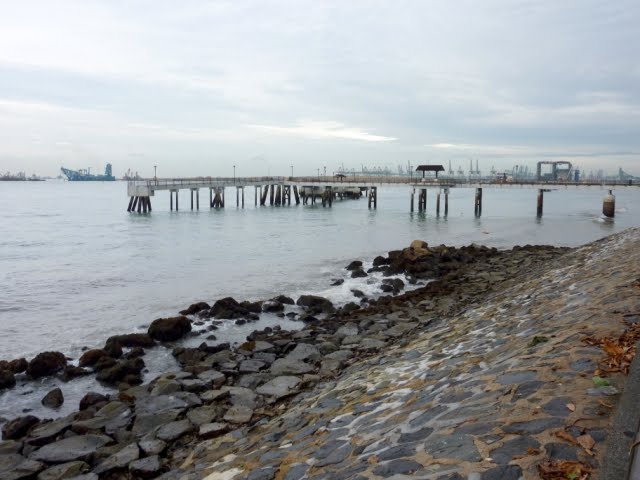
On 10 Oct 2014, I visited Labrador shore to see how it was doing. Labrador is our last natural rocky shore in Southern Singapore and it used to be much better before the surrounding reclamation began. Glad to see that the seagrasses are still thriving and that marine life is slowly coming back. Let's hope with time it will recover.


Tuesday, May 18, 2010

NIE fieldtrip to Labrador rocky shore

It has been a rainy week and I was worried if the rain will persist. Thankfully, the drizzle ended when we reached Labrador Park.


Yes, today some of the future Biology teachers were at Labrador Park for a field trip to a rocky shore. This will help us get an idea on how we can bring our students there in the future. We were fortunate to have Dr Beverly Goh, who is a marine biologist to share with us about the last mainland natural rocky reef of Singapore.

Tuesday, February 24, 2009

Labrador in black and white

Labrador in black and white exudes a charm. A rustic charm that gives a hint of what mainland Singapore used to be like: natural coastlines full of coral reefs. Rich in corals, fishes, sea stars, anemonefishes.

This is our last mainland natural rocky shore. Such a small stretch of our natural heritage contains life that is resilient. Resilient to the different impacts ranging from sedimentation, nearby dredging, poaching, trampling, pollution, dumping of trash and the list goes on.

Perhaps when the shore couldn't put on with the fight anymore, we will then begin to question ourselves why would a nature reserve suffer such a state. Everything will turn into history, just like this black and white photograph. Will Labrador survive in the long term?

Do we have to lose something precious in order to appreciate it?

-------------------------------------------------------------
Photograph taken by Feng Yikang with Canon FTB camera and Kodak T-max 3200 film.

Wednesday, February 11, 2009

To see Labrador for myself

I was at Labrador Nature Reserve with a group of friend yesterday afternoon to explore the shore during low tide.

Despite being an avid shore lover, I have not visited Labrador shore during a good low tide to take a look at the marine life there. My last two visits during 2006 (for a project) and 2007 (to check out the sad state of the shore) were during not so low tides.


This is a great view of Labrador from the top. The beginning of the jetty is where the shore lies.

Why did I named this blog post "To see Labrador for myself"? This is because of several impacts that were and are happening around the waters of Labrador like massive reclamation that will be till August 2009, post of the languishing state of Labrador shore, and the various reports of the effects of cofferdam and marine trashes on the shore.

Personally I feel that it is quite ironical that it seems the shore of only of the four nature reserves in Singapore is in a worse state as compared to many other unprotected shores.

We perhaps have this mentality that to believe something, you must see it for yourself. Thus, the objective of the trip is to look at the current state of Labrador shore for myself.


Joining me are Daniel (left) who is a Canadian exchange student, Nicholas (right) and Yikang. Yikang had his antique camera with him and he took several great shots that are black and white. Can't wait to see his photos.

Unfortunately, he told me after the trips that among the shores he visited, Labrador is the least he like because of the different pollutions like noise, smoke etc.


We arrived on the rocky shore a little earlier and explored the high shores first. One of the first few sightings include this beige flatworm.


Daniel shares with me his find of this ribbon worm (Phylum Nemertea) that was crawling across the rock wall.


You will surprised to see lots of life underneath rocks like this eerie mass of bristleworms (Class Polychaeta). Do remember to flip back the rock to its original position, otherwise the animals will die of drying out.


Another creature found beneath rocks will be this elegant looking wandering cowrie (Cypraea errones).


And also this tiny pretty orange snail that I have no idea what it is.

Soon, a bunch of girls came down to the shore where the seagrasses are. I suspect they are the RGS Labrador angels.


I approached closer and say hello to them with Andy who just joined me also. And yes, they are doing transects to study the seagrasses at Labrador park.


Andy, the girls and I noticed that the seagrasses looked a bit different today.


There was a layer of coating on the leaves and I suspect it could be due to the scorching sun, as I experienced blackening of seagrasses at Changi too. When the tide went lower, indeed the seagrasses at the lower zonation are much less affected which sort of supported my hypothesis.

The team explained that they have not seen such a phenomenon before.


The tide continued to recede and revealed several sad coral skeletons.


There was this Porites coral that was uprooted. It was partially alive at the bottom with the top layer covered by a layer of sediment and silt.


There was another Porites coral that is bleaching.


Even the coin seaweed (Halimeda tuna) is covered by sedimentation.

I walked around the intertidal area and found it in overall to be rather sad in terms of abundance and diversity of animals. It is a rather far cry as compared to the nearby Sentosa shore.


Life is resilient and I found some signs of "struggle to keep alive" spirit in this tiny Porites coral colony and the zoanthids.


Despite the heavy sedimentation and turbidity in the waters, there were still signs that Labrador may recover to its former glory if left undisturbed. I was glad to see some good growth of sponges. However, they were not abundant.


I found this lone patch of the Rubber mat zoanthids (Palythoa tuberculosa)...


while the Button zoanthids (Zoanthus sp.) were more commonly found on the rocky shore.


I was surprised to find a coral colony that is not boulder-like but is branching.


A closer look suggests that this could be the Crinkled sandpaper coral (Psammocora sp.).


There were a few boulder like corals like this faviid coral. Most living corals were found at the much lower zone of the shore. However, the abundance of corals on Labrador is much lesser than Sentosa. I hope these these surviving corals will be able to live on.

There were also several interesting reef associates that we have encountered.


Other than the swimming crabs that run away quickly most of the time, photographing this cute hairy crab (Family Pilumnidae) is not as challenging. I like their two red eyes against the camouflaging hairy body.


It was heartening to be able to sight this juvenile copperbanded butterflyfish (Chelmon rostratus) that has a false eye to distract predators.

Soon, Andy called me over to take a look at what he just found.


Wow! That's a special find of the charismatic spider conch (Lambis lambis). It seems to be a young adult to as the spines have yet grown out. Also the underside of the shell has more prominent patterns that tend to fade as the conch grows.

Andy video-ed a footage of how the conch uprights itself so watch out for that on his SG Beachbum blog.


And in no time, Andy found yet ANOTHER adult spider conch. The spider conch is usually well camouflaged with the coral rubble, so we are fortunate that Andy's keen eyes still managed to find not only one but two spider conchs.

This spider conch looks like it has sponges or ascidians on its upper shell. Seems like the upper surface is a good substrate for animals to grow, like the spider conch with coral on it found in Semakau.


Overturning the seemingly unattractive conch from the top, the underside reveals a more colourful shell with the animal within. This conch has the characteristic spines that help it to upright itself. Also worth a note will be the faded patterns as compared to the previous conch.

We proceeded on to take a look at where the cofferdam used to be and see if there is any life. Despite the rocks and surrounding looking rather boring, there was yet another special find.


We were rather stunned to find a synaptic sea cucumber (Family Synaptidae) on the rocky substrates. They are usually found at seagrass meadows or sandy substrates.


There was even another synaptic sea cucumber around the same area, this one more brown and orange in colour.


Just before we left the shore, Hang Chong, whom we met on the shores, found this Brown striped flatworm (Pseudobiceros gratus). My first sighting of this flatworm was just only the day before this Labrador trip and now again was seen. How coincidental.

Though it is heartening that life can still be found on Labrador shore, I wondered how resilient can the ecosystem be while being faced with several impacts. Will its health dwindle on or will it rebound? Nobody knows. All we know is that Labrador is obviously not thriving as well as in the past two or three years. I want to visit and see it now before it might become worse. Just in case Murphy's law work.

The natural shoreline of Labrador, though tiny and narrow, yet is still highly utilized for different purposes like recreation, education, research...


and even a wedding couple were taking photographs on the rocky shore despite the possibility of the beautiful gown being dirtied by the rocks. Wild places, though charming, are few in Singapore and we hope that the remaining wild locations be left alone for Singaporeans to visit and appreciate its beauty and tranquility.


I certainty hope that the last remaining mainland living rocky shore will be there for many generations to come for our fellow Singaporeans to enjoy.

Sunday, December 30, 2007

Current state of Labrador Park


Tanjong Rimau, Sentosa is one of the last remaining natural shores that can be publicly accessed and Naked Hermit Crabs also do guided walks to share its beauty with others.


Ironically and sadly, though Labrador is one of the lucky four nature reserve and should of course garner more care, its intertidal shore is surrounded with a lot of negative impacts.


The works done off the coast are extensive and large in scale.


These ships hug the coast of Labrador shore in numbers.


I believe all of us who are updated in blog entries would have know about the issues raised regarding the seacil project and also the cofferdam and their respective thrash left behind. Red dot blog also shows much of these impacts and also shared that the cofferdam has recently been in the process of being taken down. Therefore, I decided to check Labrador shore out myself to see if all these impacts are true before my own eyes.


Walking down the shore, there were still good growths of spoon seagrasses (Halophila ovalis).


But very soon, much of the thrash began to cover the landscape.


See it yourself.


The waters are really dirty and the whole place near the cofferdam is badly littered.


More litters at the cofferdam area.


There is this patch just at where the cofferdam used to be and the whole surrounding is like a coral graveyard. I'm saddened to see it.


The coastal cliff of Labrador Park shows history of bad landslides.


And it seems that the fallen logs were cut and left on the shore.


Another unusual phenonmenon will be these thick masses of sargassum seaweed attached on to a rock-like thing which can be concrete or dead coral. This is not the only one, they were many more of such. Was the seabed disturbed which led to these being floated to the intertidal area?

All the above photos shows my own observation of the stresses the marine environment has to tolerate against. I also tried to find as much of life in Labrador as possible which can be found below.

For all of my blogposts regarding nature, I have the luxury to select the bests of creatures to feature in the blog. However, I cannot find much life from this particular trip, so below are almost all of the marine organisms I managed to see.


Other than the mermaid's fan (Padina sp.), I managed to also find coin seaweed (Halimeda tuna).


For unknown reason, what used to be very common in Labrador I only found once for this trip. This sea grape seaweed (Caulerpa lentillifera) looks like a bunch of grapes but I only saw very little of these seaweed.


These are the few sponges that managed to survive the highly sedimented waters. I recall the Labrador waters wasn't so murked up as like for this trip.


This is a heartening sight of brittlestars still living in the crevices and holes of this sponge.


There were still mats of zoathids found littered on the grounds and rocks.


This species of zoathids looks more anemone-like.


Another type of zoathids that live in a colony on this boulder.


Also found are orange nerites, sea squirt, and two shy crabs that hid from my camera flash.


Colonial tunicate looks like slimy mud on rocks.


There were also a couple of this shorebird feeding on fishes which I have no idea of its id.


Usually these shells are found with hermit crabs, but this one is still alive.


I'm glad to still find mudskippers at the muddy parts of the shore.


This Branched-tentacle sea anemones (Phymanthus sp.) has retracted as it was exposed to air during the low tide period.


This is the most "special" find of the day for me. Quite weird for a special find, but I couldn't find anything more special in my opinion. This is a wandering cowrie that has a pretty shell. Unfortunately, they tend to be overcollected.


For a moment, it was good to still see the spoon seagrass (Halophila ovalis), tape seagrass (Enhalus acoroides) and the sickle seagrass (Thalassia hemprichii) together.


The placement of the seacil equipment however disturbed them.


I couldn't see any thing growing on these equipments. Surrounding them are pieces of stuffs including again a bunch of sargassum seaweed attached to a fragmented piece of rock.


Searching hard at the seagrass patches, I was glad to find this small piece of soft coral.


And this small boulder of hard coral (Porites sp.), which was one of the 3 small corals I've found at the vicinity for the whole trip which might reveal that corals are probably getting fewer.

But, if we give the marine environment a chance to recover by removing away the negative stresses, I believe the shore of Labrador park will recover and thrive like before. Chek Jawa is recovering well from the mass death as National Parks Board is doing a great job by ensuring no one can go down the shore except for authorized purposes and that no boat can enter the vicinity waters off Chek Jawa. Does that mean we have to lock up Labrador shore too to save it?

We as Singaporeans are stakeholders of these nature areas. As what Prof Peter Ng said in his Natural Heritage of Singapore lecture in NUS, why will we want to conserve for something we have no access to? But the issue is can we then take good care of it if we have the access to enjoy it?

Personally I have nothing against the seacil project for the objective is supposed to improve the marine life of the shores and the waters off Labrador which has good intentions. However, what made me felt uncomfortable is that they ignored our queries, for example, of the equipments that were left not taken care of on the shore.

Yes we as non-divers only can give comments on the intertidal area and from a limited point of view. And thus, all the more we should get a clearer picture of what is happening from the seacil project personnels. I hope that they will one day clear up doubts. Same too for the unexplained tons of rubbish near the cofferdam.


In all, can we Singaporeans also give our very own last rocky shore a chance to survive?

Related Posts Plugin for WordPress, Blogger...