On a Saturday morning, the last day of my 6-day consecutive low tide field trip season, I was out bring my church friends and Geraldine's friends to Kusu Island to show them the amazing creations of God in the marine habitat and coral reefs. Kusu Island is readily accessible from the city centre with a 15 minutes boat ride and one needs not to dive to experience corals and marine animals.

Kusu Island is also known as 'Turtle Island'. Some accounts say that the island originally comprised two portions which resembled a sea turtle with a larger part resembling the shell and a smaller portion the turtle's head emerging from the sea.

And all of us were very interested in knowing more about the history of this lovely small island.
I have not been to Kusu Island for almost two years and my previous trip was with Dr Daphne and the anemone team. Therefore, I was also as keen as the first timers in visiting the shores of Kusu.

What was the first star attraction that made all of us excited over?

It was the numerous number of the Common sea star (Archaster typicus) that seems to move and burrow quickly with its many tube feet. This is definitely not a clumsy animal as we witnessed and were amazed how the starfish flipped itself over from its underside to become upright.

The sandy lagoon is also where we can find many processed casts of the Acorn Worm (Class Enteropneusta). Acorn worms swallow mud and sand and process these for edible bits. At low tide, they stick out their rear ends at the surface and excrete coils of processed sediments which make up the processed cast.
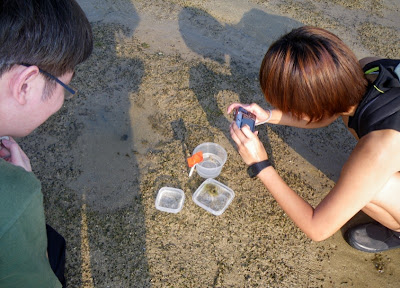
Geraldine was working hard to trying to find some animals from tidal pools and put into containers for us to see. This is what we term as hunter seeking. After which, the animals were released to where they were originally found.

Kusu is probably the best southern shore with lots of huge sea anemones and many of these Haddon's carpet anemones (Stichodactyla haddoni) can be found in the sandy lagoon. Carpet anemones are animals with stinging tentacles. They sting fishes or crabs or other animals that crossed the anemone and then swallow their prey with the mouth at the centre.
Kusu Island was originally largely made up of living reef. In 1975, there was massive reclamation to make what Kusu Island is now today, with two swimming lagoons.

It is heartening that life has crept back into the swimming lagoon with lots of different types of corals.

And there were different types of corals in different shapes and colours.
I noticed a proliferation of the Blue coral (Heliopora coerulea) (bottom left of the collage) at Kusu as compared to other southern shores!

A couple of plate-like corals seen include the Ridged plate coral (Merulina sp.) and the Thin Disk corals (Turbinaria sp.).

There were also big colonies of the stunning Galaxy coral (Galaxea sp.) that look very starry and colourful underwater. Out of water, the polyps were all retracted within the coral skeleton, thus looking boring in colour.

Walking towards the other end of the swimming lagoon, one will find lots of branching corals!

They consist of thin branched corals that are further spaced apart....

To denser branching ones that are closely compacted and thicker. I supposed these branching corals should mostly be the Montipora corals (Montipora sp.). Sometimes, seahorses can be found within the branching corals but I was rather lazy to scrutinise properly. Who knows? They might just be out there. :P

There were also quite a number of the Frilled corallimorphs in the lagoon. Though their appearance and internal structure is similar to that of hard corals, corallimorphs do not produce a hard skeleton. Corallimorphs also lack long tentacles. Therefore, they are more related to sea anemones than hard corals despite having the word "coral" in their names. Just like horseshoe crab is not more related to spiders than true crabs.

There are also many different types of soft corals at the swimming lagoon including the Omelette leathery coral.

There are also Black-and-white leathery corals too!
So what are the differences between a soft coral and a hard coral? Under a microscope or probably a good eyesight, soft coral polyps have 8 (or multiple of 8) tentacles that are pinnate (branched or feathery) while hard coral polyps have with 6 (or multiple of 6) tentacles that are smooth and unbranched.

At the coral reef area, we see more colourful and bigger anemones like this purplish Magnificent anemone (Heteractis magnifica) which is probably most abundantly intertidally at Kusu!

Another anemone species will be this Giant carpet anemone (Stichodactyla gigantea) which made us all excited! Why?

It is because one can find the famous nemo in such anemones! We were all thrilled to see a living anemonefish swimming among the giant carpet anemone.
Nemos are made popular by the movie Finding Nemo. However, the species we have in Singapore, the False clown anemonefish (Amphiprion ocellaris) is not the Clown anemonefish (Amphiprion percula) depicted in the movie. The latter lacks the black bands on the top edge of the dorsal fin. The natural distribution of these two species of anemonefishes do not overlap.
Nevertheless, non-scientists would usually get all hyped up when seeing the False clown anemonefish, without consideration whether it has black bands or not. Heehee.

As I was looking around further, I saw this interesting Decorator or Velcro crab (Camposcia retusa) that only seems to have some seaweed on its body. Yet it is still very well camouflaged. From far, if the crab is not moving, I guess none of us would have noticed this master of disguise.

Later on, I brought some of us down to another part of the shore which is bit more rocky but yet very colourful!

The reason for being very colourful must be due to the overwhelming presence of Zoanthids or colonial anemones (Order Zoanthidea). The greenish crop is actually the Coin green seaweed (Halimeda sp.).
Some zoanthids contain powerful toxins to protect themselves against predators. The most toxic marine poison, palytoxin, was discovered in a zoanthid wher minute amounts can paralyse and even kill.
Yet on the other hand, palytoxin has been used to better understand how our body works and may provide better treatment of hypertension, heart disease and other disorders. Interesting isn't it? These animals are like resources, waiting for us to discover!

While flipping rocks to look for interesting organisms, which we later found a flatworm, crabs, snails etc, there was this stunning red sponge as well! And a brittlestar was found within it!

This blue sponge was found growing together with greenish faviid corals, thus making this shore very colourful.

This yet another bluish looking creature on the shore is not a sponge nor ascidians. They are corals!

These are probably the Broad feathery soft coral! In whether, their identity as corals was a giveaway from their polyps. This bluish soft coral just looks so cool to us. :-)

Another soft coral at this rocky shore will be the cauliflower-lookalike, the Asparagus flowery soft coral.

This pretty snail could probably be drill, a member of Family Muricidae.
Nearing towards the end of the trip, the dark clouds came and showered the whole place. Thank God that He granted us good weather till almost the very end. And it was just a passing shower.

And we took a group photo together near the lagoon before we called it a day. As you can see, the background shows skyscrapers from our city centre which is very near to our natural coral reefs.
Apologies for a smiley face on one of my friend who is too shy to want to appear on photos to be published anyway. :P
In all, we had a great time together! All of my friends were first timers except for Geraldine and they have thoroughly enjoyed being outdoors looking at marine life in their wild natural setting and getting marvelled by God's wonderful creations.

All too soon, it's time to leave the island. See you next time Kusu!
Thank you my friends for giving me the privilege to show you to Singapore's true marine life other than the Underwater world. Hope you all enjoyed it and probably we'll meet at the shores again to marvel at these creatures.


.jpg)


